
One of the people we studied in my recent course of biographies was Wayne Oates.
Wayne Oates was born in 1917 and died in 1999. He lived his whole life in the USA. He had a very difficult childhood: he was abandoned by his father as a small child, and was brought up by his sister and grandmother, while his mother went to work in a cotton mill. This experience of abandonment left a deep impact on his life. He was nonetheless given opportunities to seek an education, even in the years of the Great Depression.
At 13 years of age he gained employment as a kind of errand boy, in the US House of Representatives and worked at that job in the day and went to school at night. He then went to College at Mars Hill, then at Wake Forest University. But he wanted to be a minister, so went to Southern Baptist Theological Seminary, then Union Theological Seminary, and the University of Louisville Medical School. His PhD was in the Psychology of Religion. His education and his ministry were multi-disciplinary.
He published 57 books, beginning with one on Alcohol in and out of the Church. I was very grateful in my training as a minister for his book An Introduction to Pastoral Counselling. One of his very influential books was called Confessions of a Workaholic.
He was both a Baptist pastor and teacher, and a University teacher and researcher in the areas of psychiatry and ethics.
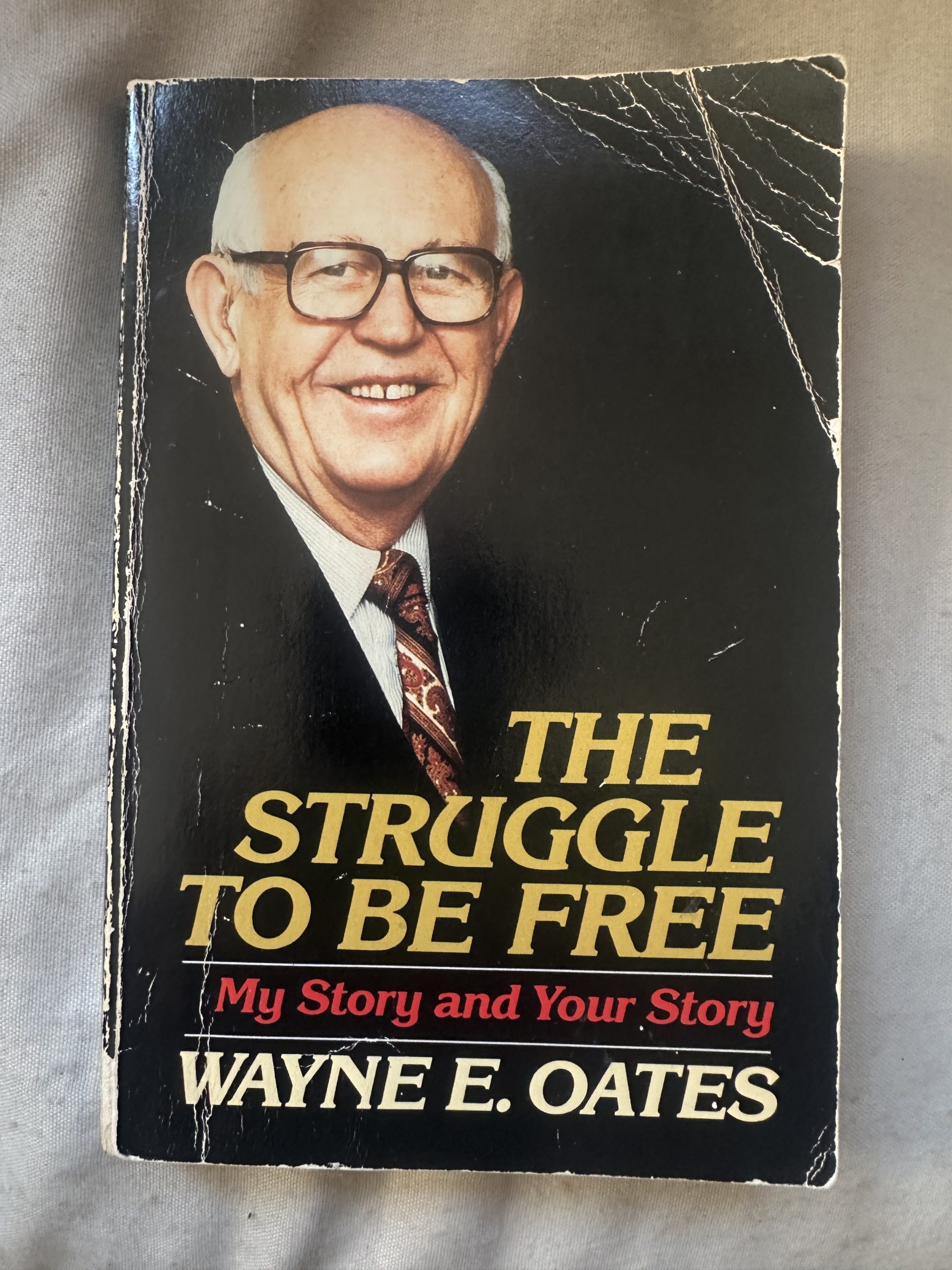 Wayne Oates wrote an exceptionally insightful and helpful autobiography called The Struggle for Freedom: My story and your story. Early in this book he reflects on the feelings of inferiority familiar to any of us who have experienced poverty and deprivation. He recounts also an amusing (though at the time hurtful) experience when he joined a church youth group, actually because he was attacted to a young woman there. Invited to join an open prayer circle, he contributed a prayer, only to be told by the all-knowing theological student leader that his prayer could not go ‘beyond the ceiling, let alone to heaven’, because Wayne had not been baptised. Oates comments, in the book, that this incident did not make him angry, as all his life he had known a sense of God, even before he had heard of Jesus or the teachings of the church.
As a college student, he reflected on his experience during the Great Depression, working with economically deprived people. What he learned from that experience was quite fundamental to his entire life’s mission. His strategy, he wrote, would be:
‘to gently take off the cheap price tags that people place on themselves and ask their permission to bestow the price tag that God our heavenly Parent has placed on us with a love that is more than human love.’ (43-44).
So many people have grown to think of themselves as ‘cheap’, even worthless. Cheap price tags have been placed on them, even by themselves. Oates suggests not only that this is not how God values us, but that we can help each other to adopt a different view.
We must resist the bargain prices! What a powerful strategy this could be and is! I believe so much of the harm that people do to each other and to the world around us arises from the defensive and destructive consequences of these debasing personal assessments, often deeply hidden by habits of outward confidence and competence.
In Romans 12, verse 3, the Apostle Paul writes,
For by the grace given to me I say to everyone among you not to think of yourself more highly than you ought to, but to think with sober judgment, each according to the measure of faith that God has assigned.
I have always wanted to insert after ‘too highly’ or too lowly!
Resist the bargain prices.
How to do this is the essence of caring relationships, beginning I think with less talk and more listening, and certainly with less assurance that we have ‘answers’ to solve other people’s problems for them. It also involves the positive abandonment of the walls we build around us and the pretence that we have no needs, fears, or failings. When we are free to do that, acknowledging our struggle to be free, others too will share the journey, and together we can move on from those cheap price tags.
I have lately been reading Dostoevsky’s novel The Idiot. It centres on a character introduced as a prince, in the pre-revolutionary Russian society. The prince is both desperately poor and has for years suffered from epilepsy and at the beginning the novel returns to Russia after some years of treatment in Switzerland under the care of a certain Professor Schneider. The prince recounts his experiences in the local village, where he found special joy in the company of children. Though others discouraged him from this, he found the honesty and insight of the children quite healing. They knew far more than their parents realised or even understood, he observed. ‘Children soothe and heal the wounded heart’, he says. ‘I remember there was one poor fellow at our professor’s [clinic] who was being treated for madness, and you have no idea what those children did for him, eventually.’
Later the prince recounts the story of an exceptionally unfortunate young woman, Marie, whose ill and socially shunned mother did not provide for her at all. Marie cared for her ‘consumptive’ mother till her death, but soon after shared the same condition (TB). She had no real chance in life, but the prince wanted somehow to help her. He says,
‘I longed to console and encourage her somehow, and to assure her that she was not the low, base things which she and others strove to make out; but I don’t think she understood me. She stood before me, dreadfully ashamed of herself, and with downcast eyes; and when I had finished she kissed my hand. I would have kissed hers but she drew it away.’
Here are the dynamics of the ‘cheap price tags’ and the ministry of inviting people to change them. But, in the story, the children now arrive and soon after, as Marie becomes more and more ill, they took up this mission. ‘So, would you believe it, they actually clubbed together, somehow, and bought her shoes and stockings, and some linen, and even a dress! I can’t understand how they managed it, but they did it, all together.’
Furthermore, when Marie could no longer get up from her bed or leave her home, the children took to visiting and caring for her, which somehow changed the hearts of the bitter and disapproving older women of the village. They now began to prepare soup and some nourishment for Marie and even spent time with her, until she died.
We must resist the bargain prices, beginning with ourselves and those nearby. Who knows where this enrichment of life and community may lead.